Grading · Richmond, VA
Yard Grading & Regrading in Richmond, VA
Before any pipe goes in the ground, the shape of the ground itself decides where water goes. Grading is the drainage solution with no moving parts — and on many Richmond lots it is the one that was never done correctly to begin with.
Three grading problems
What we are actually correcting
Negative grade
Ground falls back toward the house. Every rain delivers water to the foundation, and no gutter improvement changes that.
Flat with no outlet
Common on newer Chesterfield and Henrico rear yards. Water lands, spreads and waits. Reshaping creates a defined path.
Perched low spots
A dip left from construction, a filled stump hole or settled utility trench that collects and holds water on clay.
How a grading plan is built
It starts with elevations, not opinions. Shooting grades across the yard shows where the actual high and low points are, how much fall exists between the problem area and any usable outlet, and whether the fall is continuous or interrupted by a rise you cannot see standing in the grass.
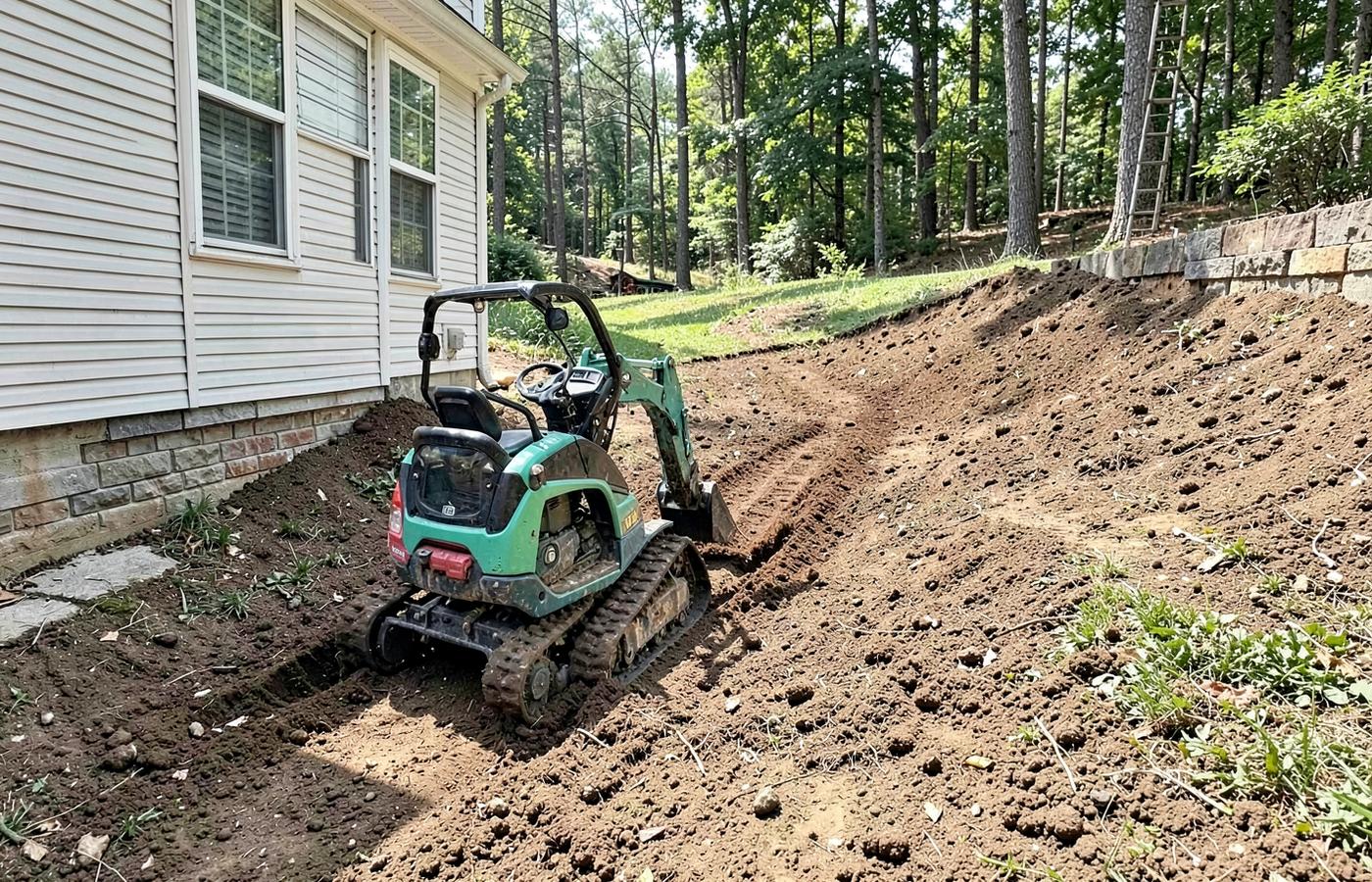
From there the surface is reshaped — cut where soil has to come off, fill where a low spot has to be raised, compacted in lifts so it does not settle back into the same dip in two seasons. On clay, working the soil at the right moisture matters; grading saturated Richmond clay produces a smeared, sealed surface that sheds water worse than before.
Finished grade is then stabilized quickly with seed, straw or sod. Bare reshaped soil on a slope is the most vulnerable surface on the property until something is holding it.
Grading plus, not grading only
Grading answers the question "which way does water travel?" It does not always answer "where does it end up?" On lots with limited fall, grading is typically paired with:
- A shaped swale to carry surface flow along a planned route.
- Catch basins at the new low point of the reshaped area.
- Buried downspouts so roof volume is not dumped onto fresh grade.
- Erosion control on any slope steep enough to move soil.
Answers
Grading questions from Richmond property owners
How much fall should the ground have away from a house?
A commonly referenced target is roughly six inches of drop over the first ten feet from the foundation, easing to a gentler slope beyond. Many older Richmond homes have lost that fall to settled soil, added mulch layers and raised beds.
Can regrading alone fix standing water?
Frequently, when there is somewhere downhill for water to go. Grading is the least mechanical solution available — nothing to clog, nothing to fail. It stops being sufficient when the whole area is flat or when the only low ground is against a structure.
Will regrading kill my lawn?
The worked area is disturbed and reseeded or sodded. Scope depends on how much surface has to move; a foundation-edge correction affects a narrow band, while reshaping a rear yard affects most of it.
Is topsoil just added on top?
Sometimes, but adding soil is not automatically grading. Fill placed without establishing continuous fall creates a new flat surface — and on clay, a shallow perched layer that stays wet. The finished contour is what matters.
Does grading affect my neighbors?
It can, and that matters on Richmond's sloped subdivisions. Reshaping a yard so water is concentrated onto an adjoining property is a problem to avoid, not a solution. Good grading plans keep flow dispersed and directed toward a legitimate outlet.
Follow the water further
Get a Free Yard Drainage Estimate
Tell us what's happening on your property and request local drainage pricing.
No obligation. Takes less than a minute.