Driveway drainage · Richmond, VA
Driveway Drainage Solutions in Richmond, VA
A driveway is a purpose-built runoff generator: several hundred square feet of sealed surface that absorbs nothing. The question is never whether it produces runoff — only where that runoff is allowed to go.
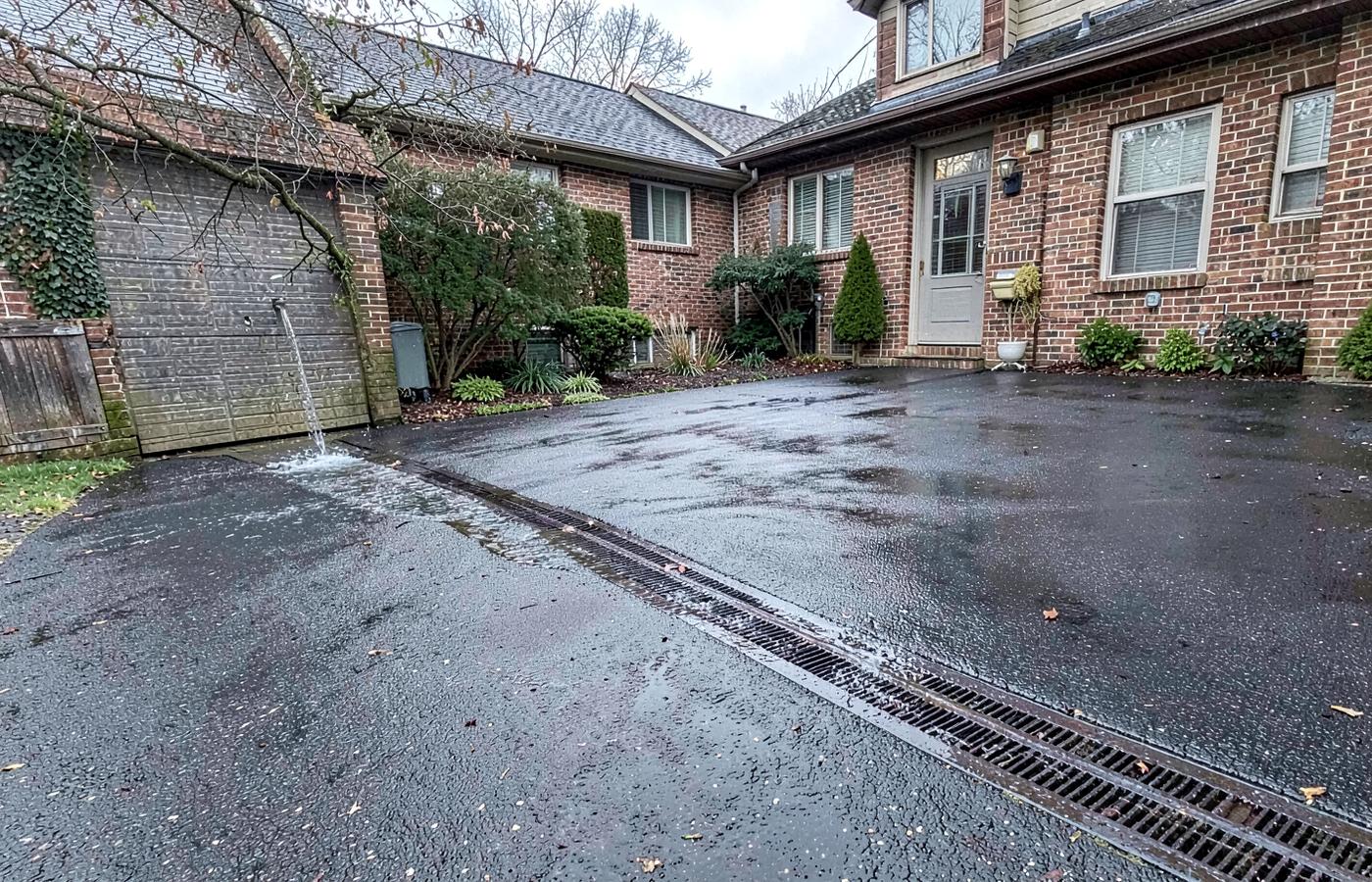
Read the flooding pattern
Water pools at the garage door
The apron or slab sits at or below the drive's low point. Interception above it, plus apron pitch correction, is the usual combination.
Water sheets across the middle
Runoff is arriving from a lawn or slope beside the drive. Handling it before it reaches pavement is cheaper than handling it after.
Water stands at the street end
The public edge is higher than the driveway low point. Collection and a piped route to a lower discharge is typically required.
Water runs down a sloped drive and washes out the edges
Common on hillside Midlothian and Powhatan lots. Cross-interception plus stabilized edges keeps the shoulder intact.
The toolkit
Channel drains. A grated linear intake set across the flow line takes the full width of moving water in one pass. Load rating and outlet capacity are the two specifications that decide whether it lasts. Details on the channel and trench drain page.
Catch basins at the low corner. Where flow gathers at a point beside the pavement rather than crossing it, a basin and piped run does the job with less surface disruption.
Grading above the drive. A slight reshaping of the lawn beside a driveway can divert runoff before it ever hits pavement — see yard grading.
Discharge planning. Everything above only works if the collected water has a lower place to go that is not your neighbor's yard.
Before anyone quotes
- How wide is the driveway at the point water crosses?
- What surface is it — concrete, asphalt, pavers, gravel?
- Is there a slope or lawn above the drive feeding it?
- What vehicles cross the proposed drain location?
- Where is the lowest point on the property that water can reach?
Answering these in your project request speeds up the review considerably.
Answers
Driveway flooding questions in Richmond
Why does my driveway flood only during heavy rain?
Because the surface can pass a light rain toward its edges but not a downpour. Once rainfall intensity exceeds what the edges and the soil beside them can accept, the surplus follows the pitch and gathers at the lowest point — usually a garage or a turnaround.
Can water be stopped before it reaches the garage?
That is exactly the goal. Interception uphill of the low point — a channel drain, a shaped swale above the drive, or a corrected pitch at the apron — is far more effective than trying to remove water after it has already ponded against the slab.
My driveway drains toward the street but still floods at the bottom. Why?
Often the street edge or gutter line is higher than the driveway's low point, or a settled apron has created a dip. Water that reaches the bottom has nowhere left to go, so it stands until it soaks in or evaporates.
Does a gravel driveway need drainage?
Gravel drives common on larger Powhatan and Goochland properties handle infiltration better but rut and wash badly when runoff runs lengthwise down them. Cross-drainage and shaped crown or side swales usually matter more than intakes.
Get a Free Yard Drainage Estimate
Tell us what's happening on your property and request local drainage pricing.
No obligation. Takes less than a minute.