Channel & trench drains · Richmond, VA
Channel & Trench Drain Installation in Richmond, VA
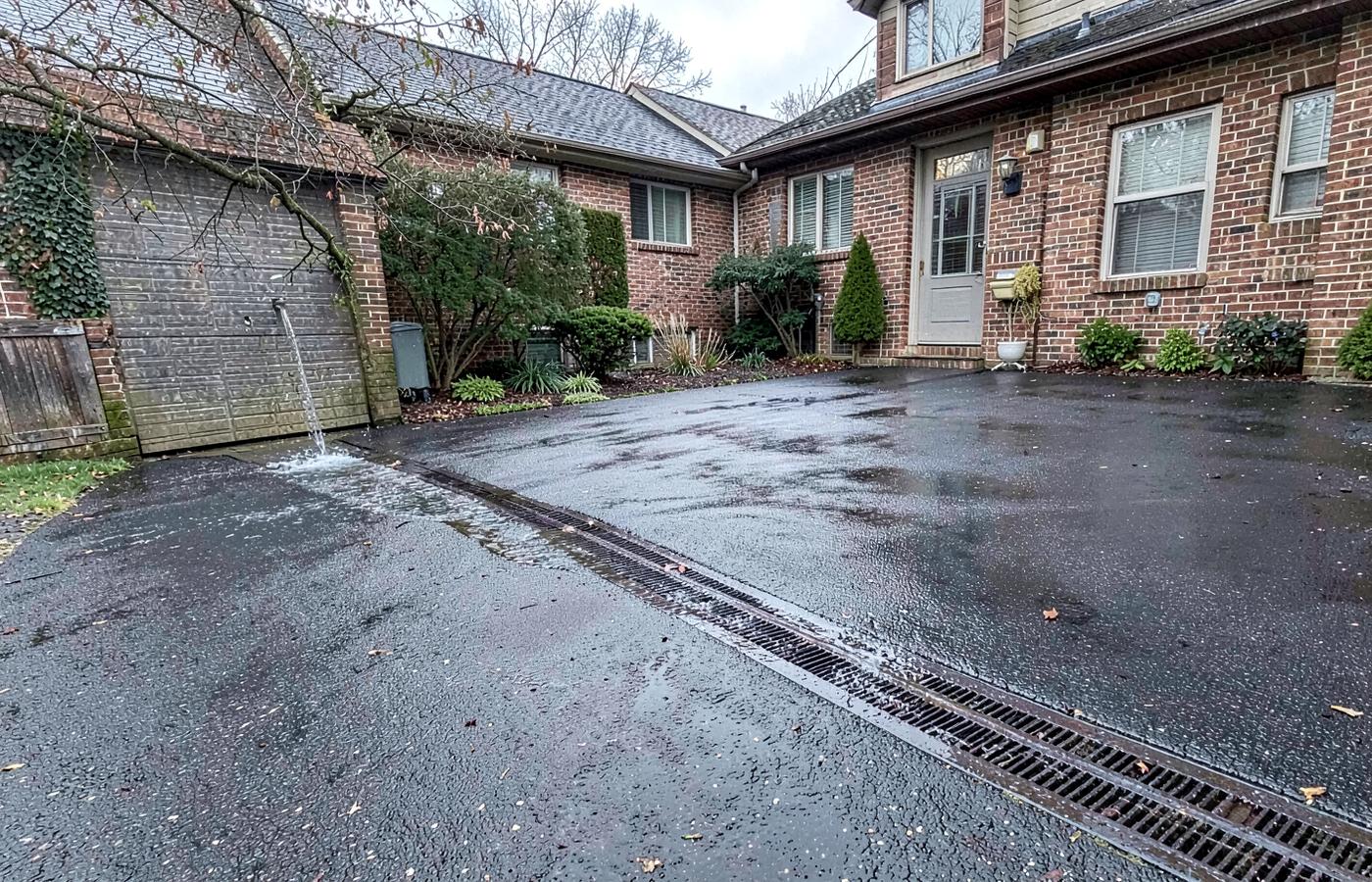
Point drains catch water where it stops. Linear drains catch water while it is still moving — which is the only way to handle sheet flow across a hard surface. That is why a driveway, apron, patio edge or walkway crossing gets a channel rather than a basin.
On Richmond properties the usual scenario is a driveway that pitches toward the house or toward a low garage slab, sometimes with a slope above it feeding additional runoff onto the pavement. A channel set across that route intercepts the entire width of flow in one pass.
Specification decisions
What gets decided before the saw cut
- Flow lineWhere water actually crosses, confirmed by watching it or reading the surface pitch.
- Length and widthEnough opening to take the peak flow of the contributing area, not a token 4-foot section.
- Load classPedestrian, passenger vehicle or truck. This drives body material and encasement.
- Grate styleSlotted, mesh or heel-safe, plus a finish that suits the drive or patio.
- Outlet routeWhere the collected water goes, and whether it joins an existing yard line.
- RestorationHow the concrete or asphalt is patched and how the joint is finished.
Common Richmond applications
- Garage apron where the drive pitches back toward the house.
- Bottom of a sloped driveway on hillside Midlothian and Powhatan lots.
- Patio or pool deck edge shedding water toward a low lawn area.
- Walkway crossings where runoff from a slope meets a hard surface.
- Between a driveway and a neighboring property to stop transfer of flow.
When a channel is not the answer
If water is arriving on the pavement because the yard above it has no drainage, the channel becomes a bandage on a bigger route problem. In that case grading or a swale above the drive comes first, and the channel handles what remains.
And if the water pools at a single point on soft ground rather than crossing pavement, a catch basin does the same work for less money.
Answers
Channel and trench drain questions
What is the difference between a channel drain and a trench drain?
In residential work the terms are used interchangeably for a long, narrow, grated intake set flush in a hard surface. Heavier commercial versions are typically called trench drains and are built with deeper, reinforced bodies for vehicle loading.
Where should a channel drain be placed across a driveway?
Across the flow line, at the point where water is still moving and before it reaches the place it collects — usually just uphill of a garage apron, a low turnaround or a sidewalk crossing. Placing it at the puddle itself means water has already arrived.
Can a channel drain be cut into existing concrete or asphalt?
Yes. The surface is saw-cut, the channel is set to grade and encased, and the surface is patched. On asphalt driveways the patch is visible; on concrete it is usually formed as a clean band, which many Richmond homeowners prefer aesthetically.
Do channel drains handle heavy vehicles?
Load class matters. A light-duty plastic channel will fail under repeated truck traffic; a properly load-rated body and encasement will not. Tell whoever reviews your project what drives over it.
Get a Free Yard Drainage Estimate
Tell us what's happening on your property and request local drainage pricing.
No obligation. Takes less than a minute.