Buried downspouts · Richmond, VA
Buried Downspout Drainage in Richmond, VA
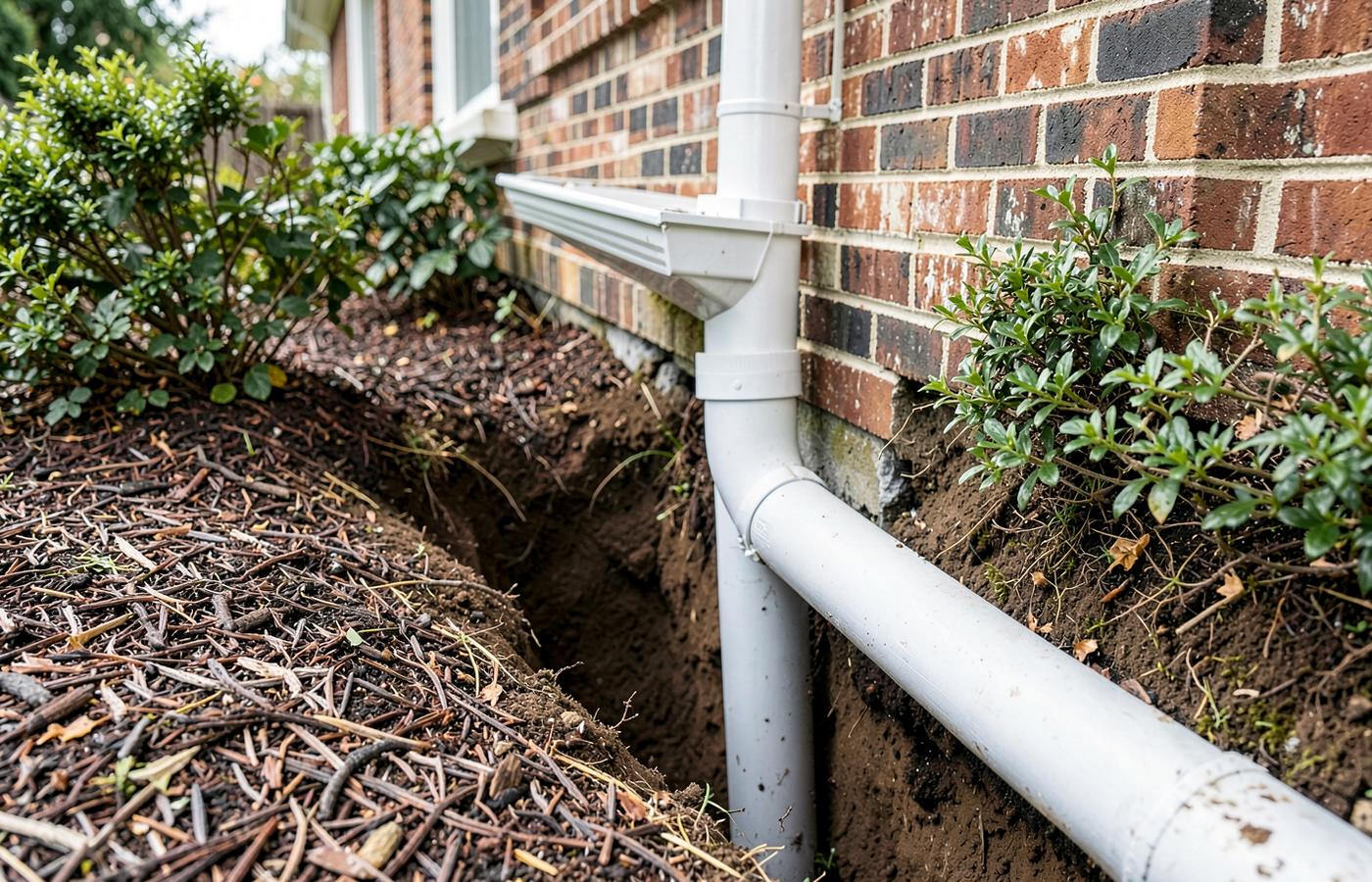
The single highest-volume water source on a residential lot is the roof, and on most Richmond homes it is released three feet from the foundation. Piping that discharge to a controlled outlet resolves a surprising share of soggy yards and damp foundation edges.
- Volume
- ≈600 gallons per inch of rain on 1,000 sq ft of roof.
- Release point
- Typically within 2–4 ft of the foundation on Richmond homes.
- Result
- Saturated soil beside the house and a permanently soft yard band.
What the install involves
A collection fitting replaces the splash block at the base of the downspout and drops into solid pipe. The trench holds a continuous slope to the discharge, crossing beds and lawn at a depth that clears mowing, planting and — where the route crosses a drive or walk — the surface above it.
Cleanouts are placed where the line turns, so a clogged length can be flushed without excavation later. Multiple downspouts are commonly manifolded into a single larger trunk line, sized so the combined roof flow does not exceed what the pipe can pass.
The end of the line is the part that gets skipped and the part that decides whether the system works: a pop-up emitter on lower ground, a stone-armored daylight outlet, or a tie-in to an existing yard system with capacity to spare.
Signs your roof water is the problem
- A worn, eroded or mossy circle right where the splash block sits.
- Mulch washed out of the bed nearest a downspout after every storm.
- A wet band of lawn that traces a straight line away from the house.
- Basement or crawl space humidity that spikes after heavy rain.
- Silt fans across the driveway from the corner of the house.
Where it pairs
Roof lines frequently tie into a catch basin mid-yard, and on lots where the surface also holds water, into a shared outlet with a yard drainage system. Where the ground near the house also falls the wrong way, regrading belongs in the same project.
Answers
Buried downspout questions Richmond homeowners ask
How much water actually comes off a roof in Richmond?
A one-inch rain on 1,000 square feet of roof produces roughly 600 gallons. Split across two or three downspouts, that is a few hundred gallons released at each discharge point — usually within a few feet of the foundation.
Should buried downspout pipe be solid or perforated?
Solid. The job is transport, not infiltration. Perforated pipe on a roof line dumps concentrated roof volume back into the soil along the route, which is exactly the outcome you were trying to avoid.
What happens at the far end of the pipe?
Ideally a daylight outlet on lower ground, with a pop-up emitter or a stone-armored discharge. Where a lot has no fall, a bubbler basin or a designed dispersal area may be used instead. The end of the line always needs a plan.
Do buried downspouts freeze in Richmond winters?
Rarely a functional problem here. Short exposed ends can ice briefly during a hard freeze; a properly sloped line drains itself between storms rather than holding standing water.
Can existing underground downspout lines be reused?
Sometimes. Older corrugated lines on Richmond-area homes are frequently crushed, disconnected at the elbow, root-filled or terminating in nothing. They can be scoped and flushed before anyone assumes replacement.
Get a Free Yard Drainage Estimate
Tell us what's happening on your property and request local drainage pricing.
No obligation. Takes less than a minute.