French drains · Richmond, VA
French Drain Installation in Richmond, VA
A French drain is a gravel-wrapped, perforated pipe that gives water a faster path than the soil around it. In Richmond's clay, that speed advantage is the whole point — and the outlet is what makes it real.
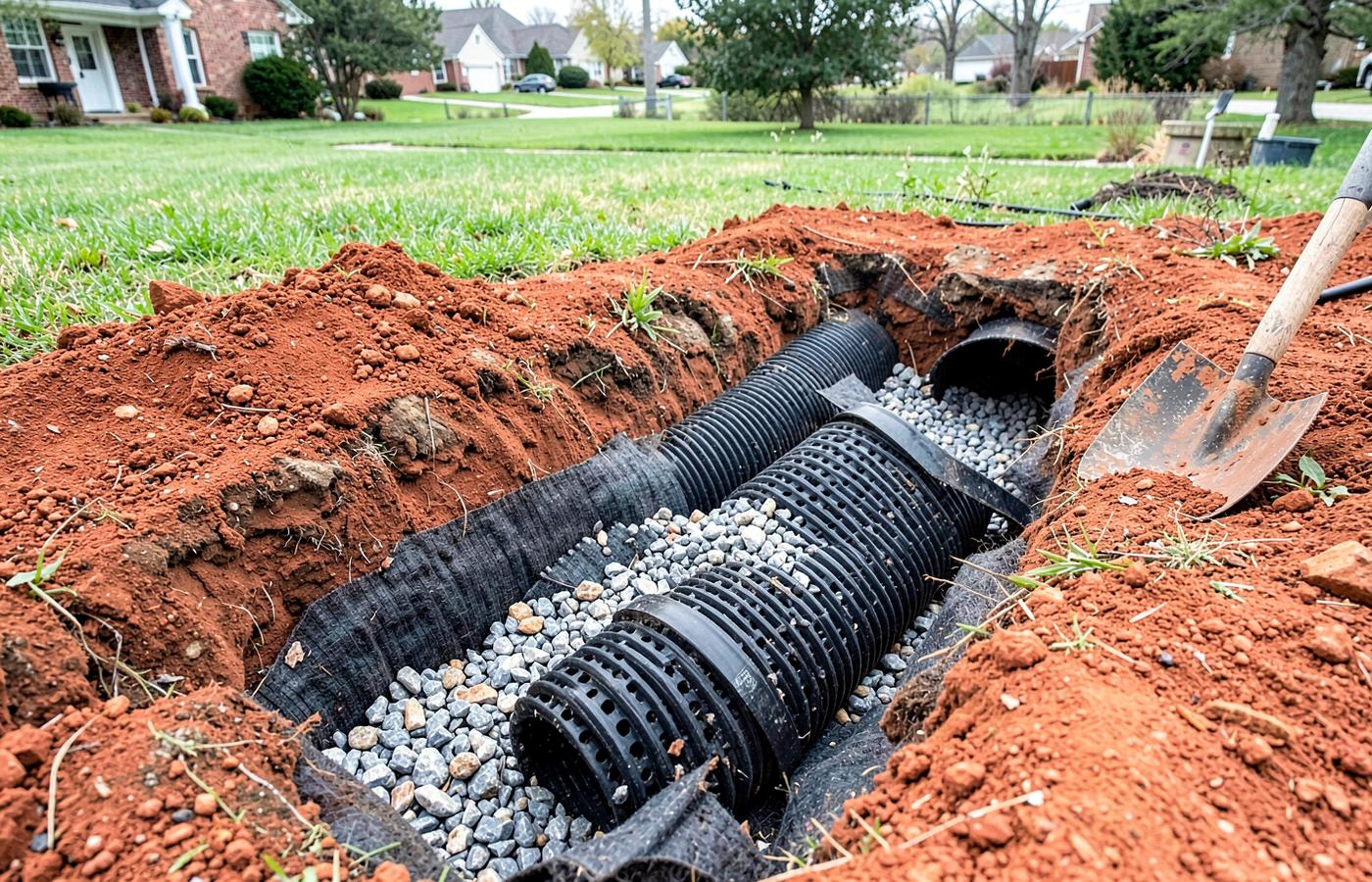
How it actually works
Four parts, one job
- 01Trench with fallCut at a continuous downhill slope toward the outlet — no flat sections, no reverse dips.
- 02Filter fabricWraps the stone so clay fines cannot migrate in and choke the void space.
- 03Perforated pipeSits in washed stone and carries intercepted water at a speed soil never could.
- 04A real outletDaylight on a lower grade, a rear low point, or an approved structure. Without it, the trench becomes storage.
Good fit
- Broad soggy areas rather than one defined puddle.
- Water seeping along the base of a slope on a wooded lot.
- Chronically saturated ground beside a patio, wall or foundation.
- Runoff arriving as sheet flow from an uphill neighboring property.
- Side yards between Richmond homes that never dry out.
Consider something else
- Water pools at one visible low point — a catch basin may be faster and cheaper.
- Problem is entirely roof volume — buried downspouts first.
- Ground slopes back toward the house — regrading comes before pipe.
- No lower discharge point exists anywhere on the property.
Cost drivers on Richmond properties
Linear footage and depth. Every foot is excavation, stone, fabric, pipe and restoration. Depth compounds all of it.
Access. A gate too narrow for a mini excavator turns machine hours into hand-dig hours in dense clay.
What the route crosses. Driveways, walkways, irrigation, mature roots and finished beds all add restoration scope.
Estimated Richmond range for French drain work: approximately $2,000 – $6,000+. See the full cost guide. Figures are estimates, never guarantees.
Answers
French drain questions, answered for Richmond conditions
How deep is a typical residential French drain?
Most residential runs sit somewhere around 12 to 24 inches deep, but depth is set by the fall available to the outlet, not by a rule. On flat Richmond lots the drain often starts shallow and deepens along the run to hold slope.
Do French drains work in clay soil?
Yes, provided they are built to intercept rather than to infiltrate. In tight clay, water does not soak downward into the trench from all sides — the drain works because the stone envelope and perforated pipe give water a faster path than the surrounding soil, and because that path ends somewhere lower.
Why do French drains fail?
Three common reasons in this market: no filter fabric or the wrong fabric, so fines silt the stone; insufficient or reversed fall over a long run; and an outlet that was never truly lower than the inlet or has since been buried.
Can a French drain be installed near trees?
Often, with route adjustments. Mature hardwoods on wooded Richmond lots have wide root plates, and cutting a straight trench through them is both bad for the tree and hard on the pipe. Routes are usually curved around the critical root zone.
French drain or surface drain?
If the water is visible and pools at a point, a surface intake removes it faster and costs less. A French drain earns its cost when water is spread across an area, saturating soil, or arriving as subsurface seepage along a slope.
Get a Free Yard Drainage Estimate
Tell us what's happening on your property and request local drainage pricing.
No obligation. Takes less than a minute.