Catch basins · Richmond, VA
Catch Basin Installation in Richmond, VA
A catch basin is the simplest honest answer to a puddle: an intake set at the exact low point, a sump to hold the silt Richmond clay produces, and a pipe that carries the water somewhere lower. Most of the skill is in placement.
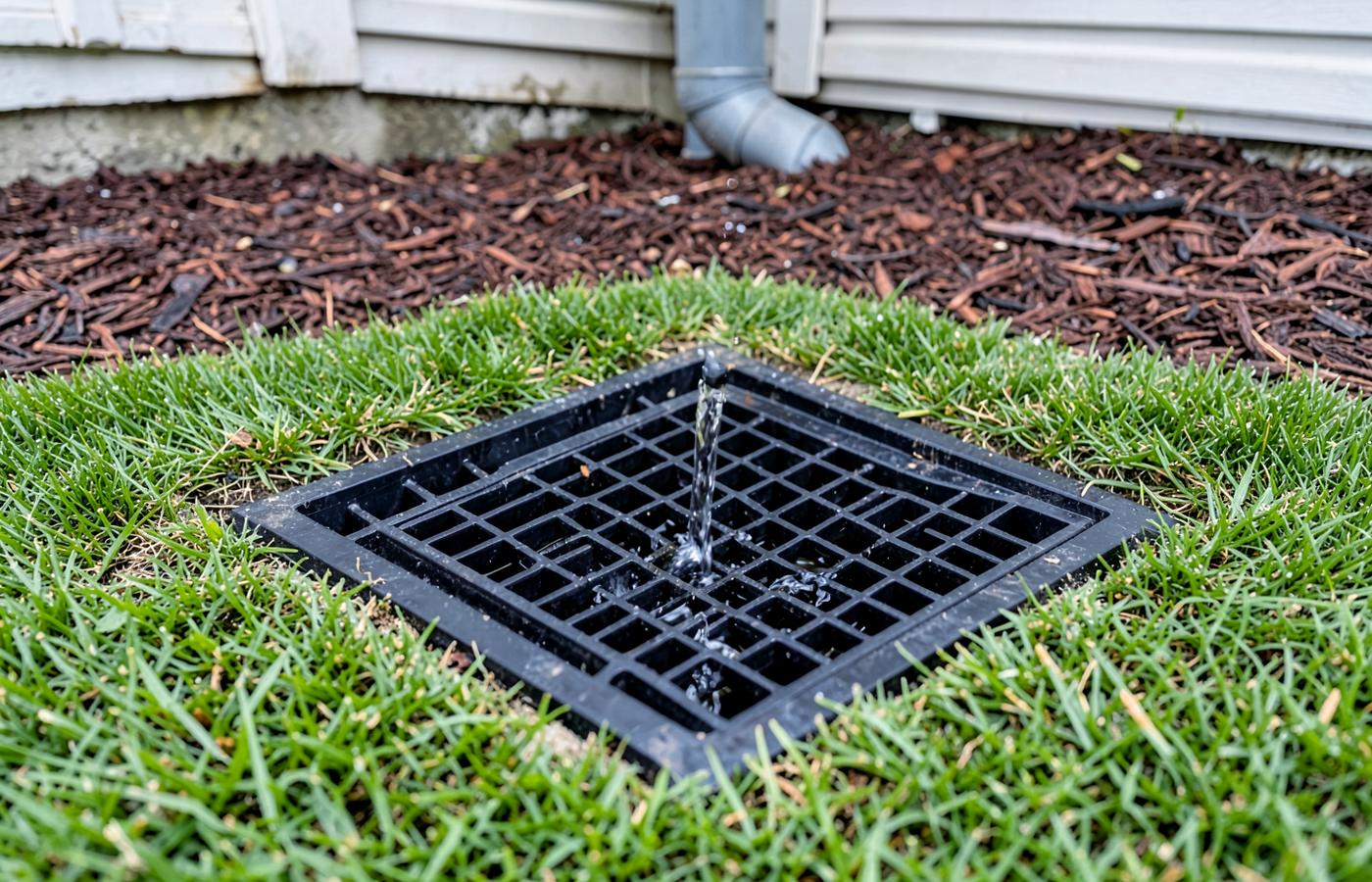
Homeowners often place a basin where the water is most annoying — beside a patio or path. Water does not care about convenience. It goes to the lowest elevation available, and a basin two feet uphill of that point will stay dry while the puddle stays wet.
Getting placement right means shooting grades, not eyeballing the lawn. On a flat Henrico or Chesterfield backyard, two inches decides everything.
Anatomy of a working basin
Grate
Flush with finished grade so water enters and mowers pass.
Body
Sized to the flow feeding it, not to the smallest box available.
Sump
Dead space below the outlet where silt and grit settle out.
Outlet
Pipe leaving at a slope that carries flow to the discharge point.
Where basins earn their keep locally
Richmond's older neighborhoods have mature grades and mature trees; the low spots are established and predictable, and a basin plus a short piped run usually clears them. Newer subdivisions have the opposite problem — broad, nearly flat rear yards with compacted subsoil, where a basin only works if the outlet has been found first.
Basins also serve as junction and access points. Where a downspout line, a yard intake and a French drain all need to reach the same outlet, a basin becomes the meeting point and the place you can later flush the line.
When a basin is the wrong tool
- Water is spread out, not pooled. Broad saturation calls for linear interception instead.
- The whole area is a bowl. If there is no lower ground within reach, an intake has nowhere to send water.
- Flow crosses pavement. Sheet flow across a driveway wants a channel drain, not a point intake.
Answers
Catch basin questions from Richmond yards
How many catch basins does a yard need?
One per genuine low point that collects water, plus intermediate basins where several lines join or where a long run needs a cleanout access point. Adding basins where water does not naturally gather accomplishes nothing.
Do catch basins clog?
Grates catch leaves, and on wooded Richmond lots that happens fast in October and November. Most residential basins include a sump below the outlet that traps sediment; clearing the grate and pulling debris from the sump once or twice a year keeps the system moving.
Can a downspout tie directly into a catch basin?
Yes, and it is a common combination — the roof line drops into the basin body and shares the outlet pipe. Sizing matters: a single roof plane can deliver more volume than a small basin and undersized pipe can pass.
What size grate is used in a residential lawn?
Nine to twelve inch grates cover most lawn applications, with larger sizes where flow concentrates. Grate choice also affects mowing — flush installation is not optional if you want to keep the mower deck intact.
Related drainage solutions
Get a Free Yard Drainage Estimate
Tell us what's happening on your property and request local drainage pricing.
No obligation. Takes less than a minute.