Service area · Henrico County
Yard Drainage Solutions in Glen Allen, VA
Glen Allen mixes established neighborhoods with newer subdivisions, and the drainage problems split along the same line. Older sections deal with failed buried lines and settled grades; newer sections deal with flat rear yards over compacted clay. Both come down to one question: where can water actually go?
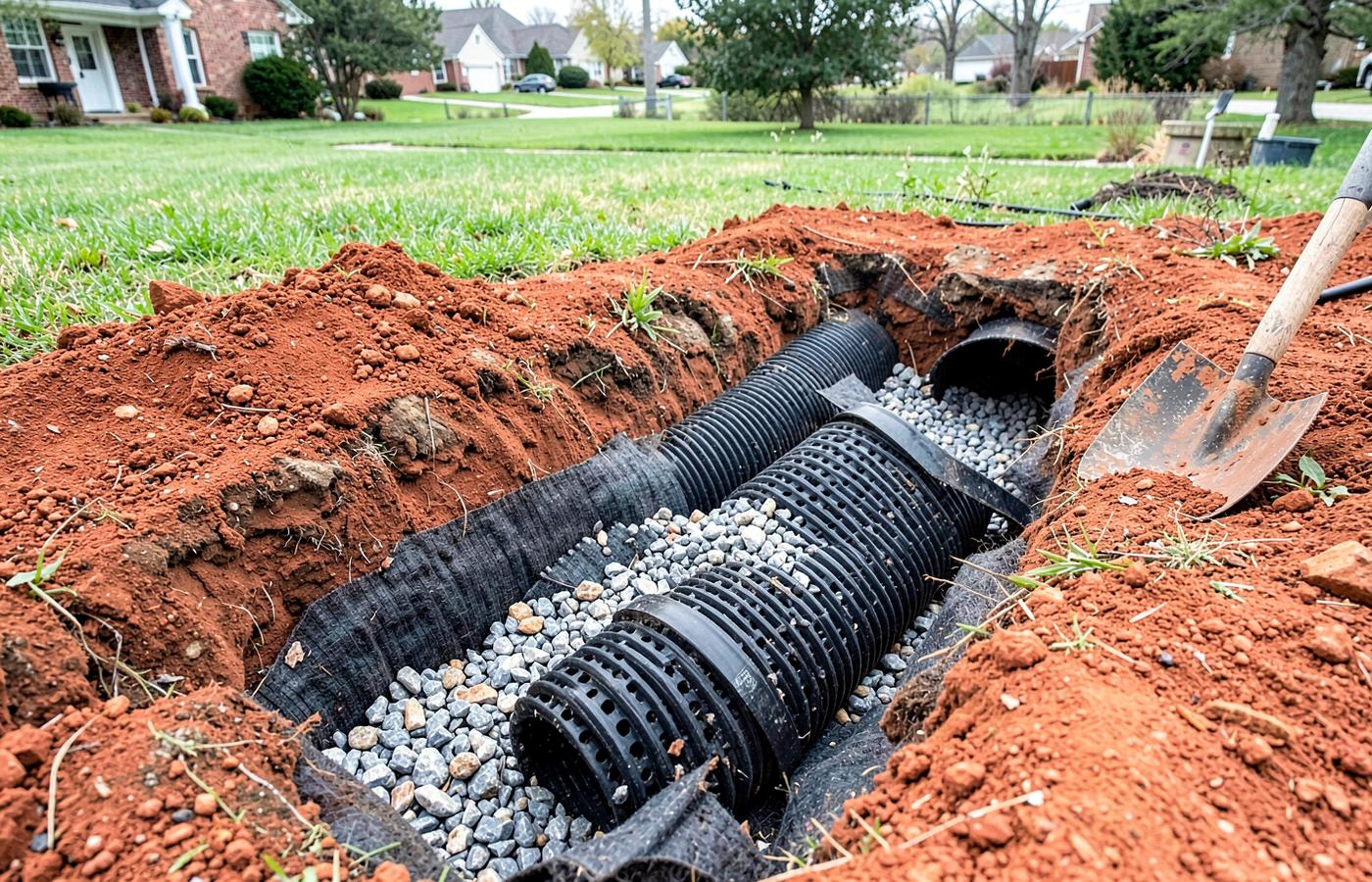
The flat-lot problem
A yard with fall has options. A yard without fall has exactly one: find the least-high ground within reach and engineer a path to it. That is why a professional walking a flat Glen Allen backyard spends most of the visit looking at everything except the puddle.
Grades get shot across the whole property, including the front, the side yards and the street edge. Sometimes the only viable outlet is on the opposite side of the house from the problem, and the project becomes a long trunk line rather than a local fix.
Where nothing lower exists at all, the conversation shifts to dispersal across a wider area, storage that releases slowly, and reducing input volume — starting with roof water, which is the one input you can fully control.
Failed legacy lines
Many established Glen Allen homes already have underground downspout piping installed years ago. A large share of it no longer works: crushed under a driveway, disconnected at the elbow, filled with silt, root-invaded or discharging into a buried outlet nobody has seen in a decade. Before assuming a new system, existing lines are worth locating, flushing and scoping — the cheapest drainage fix is often the one already in the ground.
Typical Glen Allen project shapes
- 01Roof-first correctionReconnect or replace downspout lines and carry them to a real outlet.
- 02Single collection pointOne basin at the true low spot with a piped trunk to the least-high ground.
- 03Edge interceptionA French drain or swale where flow arrives from an adjoining property.
- 04Surface reshapingGrade correction where the fall exists but is interrupted by a settled dip.
Answers
Glen Allen drainage questions
My Glen Allen backyard is flat and stays wet. What are the options?
On a flat lot the discharge point decides everything. A professional looks for any lower ground within reach — a rear corner, a swale between lots, a street-side low point — and designs the collection system backward from there. Where nothing lower exists, dispersal or storage approaches are considered instead.
Are older Glen Allen neighborhoods different from newer ones?
Yes. Established sections often have mature trees, settled grades and aging underground downspout lines that have failed quietly. Newer sections tend to have compacted subsoil, larger roofs and shallower topsoil over clay.
Can drainage tie into an existing storm structure?
Sometimes, subject to local requirements and the structure's ownership and capacity. It should never be assumed as the outlet before it has been confirmed.
What if my neighbor's yard drains into mine?
Interception along the shared edge is the practical answer — a swale, a French drain or corrected grade that captures the incoming flow and routes it away without pushing the problem back the other direction.
Where Glen Allen projects usually start
Get a Free Yard Drainage Estimate
Tell us what's happening on your property and request local drainage pricing.
No obligation. Takes less than a minute.