Diagnosis · Richmond, VA
Standing Water in Your Yard in Richmond, VA
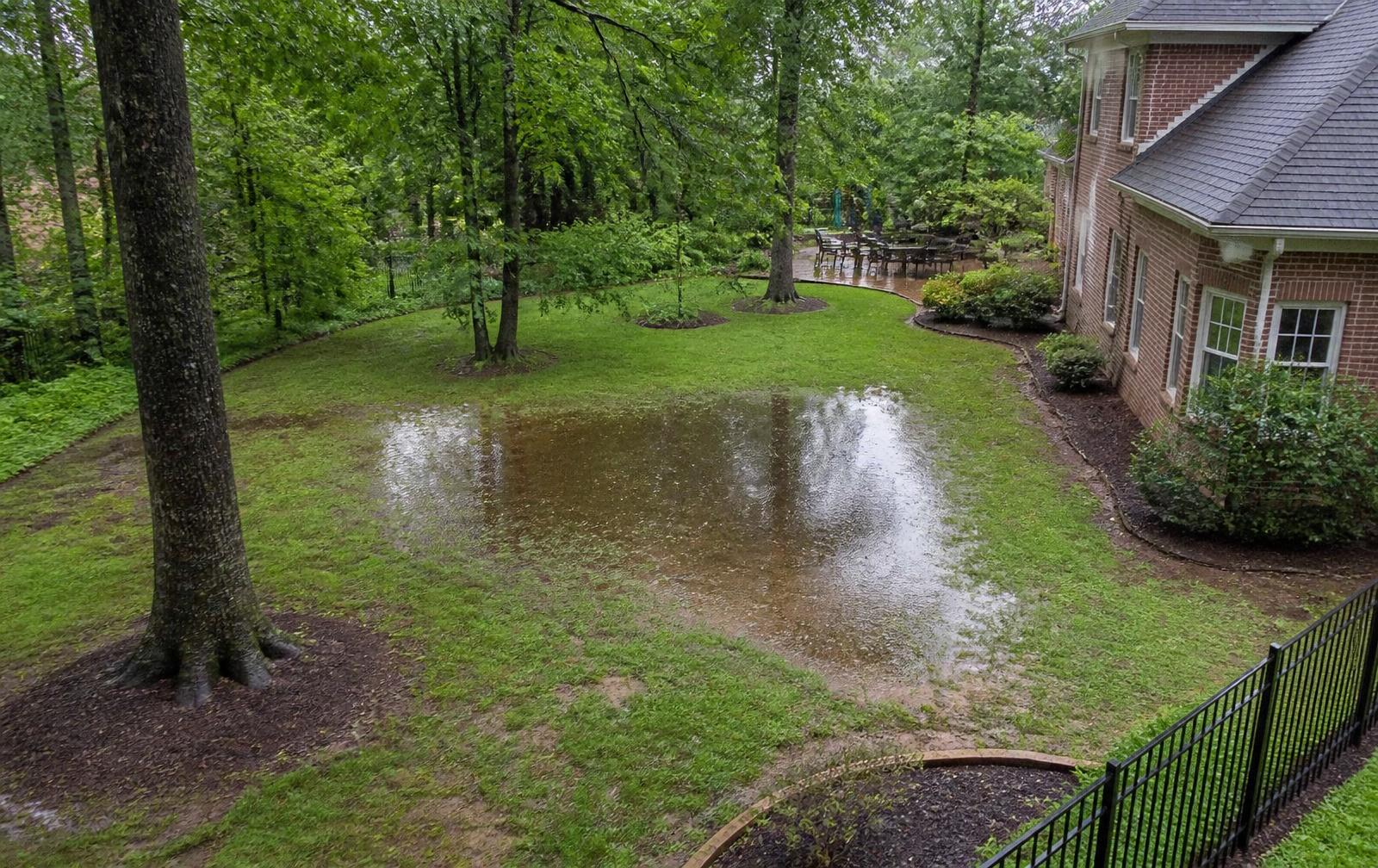
Standing water is a symptom, never a diagnosis. Somewhere on the path from roof to outlet, water is arriving faster than it leaves — and the fix depends entirely on which part of that path broke.
Self-diagnosis
Match the behavior, find the cause
What that usually means
Low spots plus tight clay mean water has nowhere to infiltrate. Collection points and corrected fall usually come first.
The four causes behind most Richmond puddles
1. Soil that cannot take it. Piedmont clay accepts water slowly at the best of times. After construction compaction, the top layer saturates in minutes and everything after that runs off or sits.
2. A low spot with no exit. Every yard has a lowest point. If that point has no path to somewhere lower, it functions as a basin — and it will hold every inch of rain that reaches it.
3. Too much concentrated volume. A roof discharging hundreds of gallons through two downspouts, or a driveway sheeting runoff into one corner of the lawn, overwhelms ground that would otherwise cope.
4. Water arriving from off-property. On sloped Richmond subdivisions, uphill neighbors contribute runoff you did not generate. Interception at the property edge often matters more than anything done in the middle of the yard.
A useful observation exercise
During the next steady rain, put on boots and walk the property. Note where water enters, the direction it travels, where it slows, and where it stops. Photograph each of those points. That five-minute walk tells a drainage professional more than any description written afterward — and photos can be noted with your project request.
Solution mapping
| What you see | Likely first move |
|---|---|
| A defined puddle in the same spot | Catch basin at the true low point with a piped outlet |
| Broad soggy area, no single puddle | French drain interception across the wet zone |
| Wet band along the foundation | Regrading, then roof water rerouting |
| Soft ground under a downspout | Buried downspout line to a controlled outlet |
| Water crossing from uphill | Swale or interception along the property edge |
| Puddling on and beside pavement | Channel drain across the flow line |
Answers
Standing water questions from Richmond homeowners
How long can water stand in a yard before it's a problem?
If surface water is still there 24 hours after the rain stops, the yard is storing water rather than draining it. Repeated multi-day standing water kills turf roots, invites mosquitoes and keeps soil beside foundations saturated.
Is standing water bad for my foundation?
Persistently saturated soil against a foundation is worth taking seriously — it raises hydrostatic pressure, keeps crawl space humidity high and accelerates soil movement in expansive clay. Moving that water away is the point of the whole exercise.
Why does a soggy yard appear after years with no problem?
Something changed the water path: gutters clogged or a downspout line failed, a neighbor regraded or built, a tree came down, mulch and beds raised the grade near the house, or soil settled into a new low spot.
Can I fix standing water by adding topsoil?
Filling a low spot moves the problem rather than solving it, unless the fill is part of establishing continuous fall to somewhere lower. On clay, added soil over a compacted layer often just perches water higher up.
Does aeration help a soggy Richmond lawn?
Aeration and organic matter improve infiltration at the surface and are worth doing, but they cannot make clay subsoil accept water fast enough to clear a genuine low spot. They complement drainage work rather than replacing it.
Follow the water further
Get a Free Yard Drainage Estimate
Tell us what's happening on your property and request local drainage pricing.
No obligation. Takes less than a minute.